
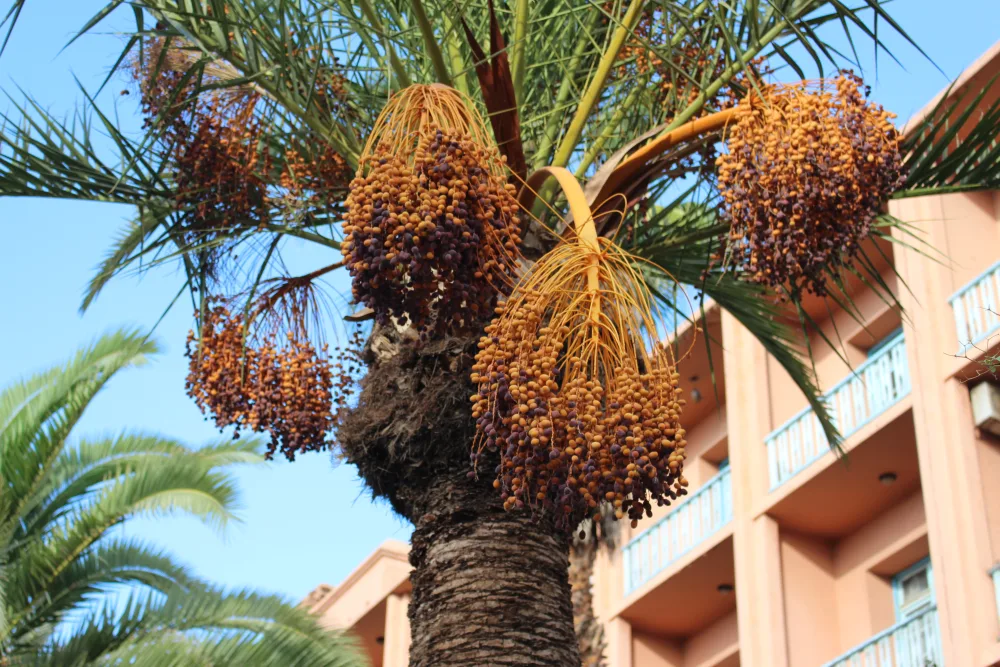
Picture five in the morning on the edge of a desert city: a line of refrigerated pickups stretching beyond sight, each loaded with tons of freshly picked golden dates. That scene is real, and it repeats every harvest season in Buraidah, capital of Saudi Arabia's Al-Qassim Province — host of the world's largest date market. For anyone serious about understanding the sukkari variety, every road of knowledge starts here.
Al-Qassim: The Province of 8 Million Date Palms
Before the market, meet the region. Al-Qassim is a fertile plain in the heart of the Arabian Peninsula, threaded by ancient valleys (wadis) with relatively shallow groundwater — a rare combination in a desert nation. The result: the province holds more than 8 million date palms (some sources count up to 11 million) and produces around 205,000 tons of dates per year, making it one of the Middle East's biggest date producers — the Saudi province with the highest palm population, ahead of Madinah and Riyadh. This is the soil that created sukkari, and where its golden character is forged: long, dry summers concentrate the sugars while wadi water keeps the flesh tender.
A 45-Day Festival Trading 300 Thousand Tons a Year
Each harvest season — roughly August into September — Buraidah stages a giant date festival running about 45 days. The numbers are hard to believe until you see them:
- Around 300 thousand tons of dates are traded per year through the city.
- At peak season, roughly 1,500 date-carrying vehicles enter the city every day.
- Business runs on open auctions: auctioneers walk among mountains of dates calling prices as traders from across the Gulf bid.
Sukkari is the star. Arab News reporting from the Buraidah date carnival (2024) ranks it the most sought-after variety — with extreme price spreads: ordinary lots from 5 riyals per 3kg up to top auction lots bid to 700 riyals. In Buraidah, quality genuinely gets priced.
National Context: Saudi Arabia's Date Machine
A market this size only exists because of the production machine behind it: Saudi Arabia grows about 1.9 million tons of dates a year and exports to 119 countries. Buraidah serves as its main auction floor — where benchmark prices form and export contracts begin. When you pay for a box of sukkari in Jakarta, its price chain almost certainly passed through one of this city's busy dawns.
From a Buraidah Auction to a Cakung Warehouse
How do festival dates reach Indonesian tables? Roughly like this:
- Auction/orchard contract — an importer or agent buys lots by grade and stage (rutab or tamr).
- Packing house — size and color sorting, packing, and chilling for rutab lots.
- Container — refrigerated for rutab, dry for tamr/mufattal, sailing for Tanjung Priok.
- Importer's warehouse — in our case Cakung, East Jakarta, where lots are re-sorted before delivery across Greater Jakarta.
The demand side is just as large: Indonesia's statistics agency (BPS) recorded 32.89 thousand tons of date imports worth US$38.76 million in January-February 2025 alone, with Saudi Arabia the second-largest supplier (13.87%). Imports start climbing about five months before Ramadan — meaning Al-Qassim containers are booked long before Indonesian markets get busy.
Following the Season from Indonesia
You do not need to fly to Saudi Arabia to ride the season. Buraidah festival coverage appears every August-September across news wires and media — that is when the new season's benchmark prices first become readable. For home buyers the signal is simple: once festival news circulates, fresh-harvest lots are being auctioned, and new stock reaches Indonesia a few weeks later by sea. A good importer will gladly tell you where their lots sit on that calendar — we share container arrival news with any customer who asks, because buyers who understand the season are the ones who most appreciate good fruit.
Scale Breeds a Culture of Quality
Buraidah's giant numbers are not mere trivia — they explain why Al-Qassim dates are so consistent. When 1,500 vehicles unload every morning, buyers have choices; when buyers have choices, careless growers get filtered out on their own. Open auctions tie price to quality nakedly: uniform lots at the right stage fetch multiples, mixed lots fetch scraps — all in public view. It is this quality-judging culture, not climate alone, that gives the word "grade" real meaning on Saudi dates. And it is the same culture we carry home as the sorting standard at our Jakarta warehouse.
Lessons for Buyers in Indonesia
What does all this mean if you buy sukkari in Jakarta, Bekasi, or Depok? Three things. First, ask your seller about lot origin — a good seller knows the orchard or at least the auction route. Second, understand that wide price ranges are normal; they reflect grade, not just the variety name. Third, respect the season: the best rutab follows Buraidah's harvest calendar, not a store's promotion calendar. Those are the three principles we run our warehouse by — and why this encyclopedia is written from experience, not translation. Curious where our lots sit on this season's Buraidah calendar? We share container arrival news anytime on WhatsApp +62 823-4350-8579.


